Pediatrics CME
1 - 15 of 39 results
-
FEATURED
BoardVitals Pediatrics CME Board Review
The BoardVitals Pediatrics CME Review offers clinicians 45 AMA PRA Category 1 CreditsTM, 45 ABP MOC points, and over 1,400 Pediatrics board review questions. The questions cover key topics including adolescent care, child abuse, and psychosocial issues. This question bank will assist clinicians with Pediatrics certification and recertification.
The BoardVitals Pediatrics CME Review also features:
- Quick and Convenient CME
- Computer, phone, and tablet access
- Constantly updated up-to-date questions
- Questions that are targeted specifically to the exam
- Online CME tracker
- 100% Pass Guarantee
- Statistical comparison to other Pediatrics test-takers (Nationally)
After completing this activity, you should be able to:
- Provide current guideline-based approaches to the topics presented
- Improve your ability to diagnose and manage patients in these areas
- Incorporate evidence-based changes into your practice
Target Audience: Pediatricians
See full details chevron_right- Cost: $599
- Credit hours: 45
- CME credits awarded by: BoardVitals
- Format: On-Demand Online
- Material last updated: Continuously Updated
-
The Ultimate Master Clinicians CME Conference Bundle
Grow your clinical expertise with The Ultimate Master Clinicians CME Conference Bundle, an expert-led curated series covering urgent care, telemedicine, women’s health, and more. Designed for the clinician’s busy schedule, these on-demand lectures offer useful insights and knowledge to improve decision-making and treatment strategy.
See full details chevron_right- Cost: $849
- Credit hours: 53.5
- CME credits awarded by: Master Clinicians is accredited by the Accreditation Council for Continuing Medical Education (ACCME) to provide continuing medical education for physicians. This educational activity is eligible for 53.5 Category 2-B credit hours by the American Osteopathic Association.
- Format: On Demand Online
-
SAVE 50% OR EARN UP TO A $3200 GIFT CARDFEATUREDRECOMMENDED
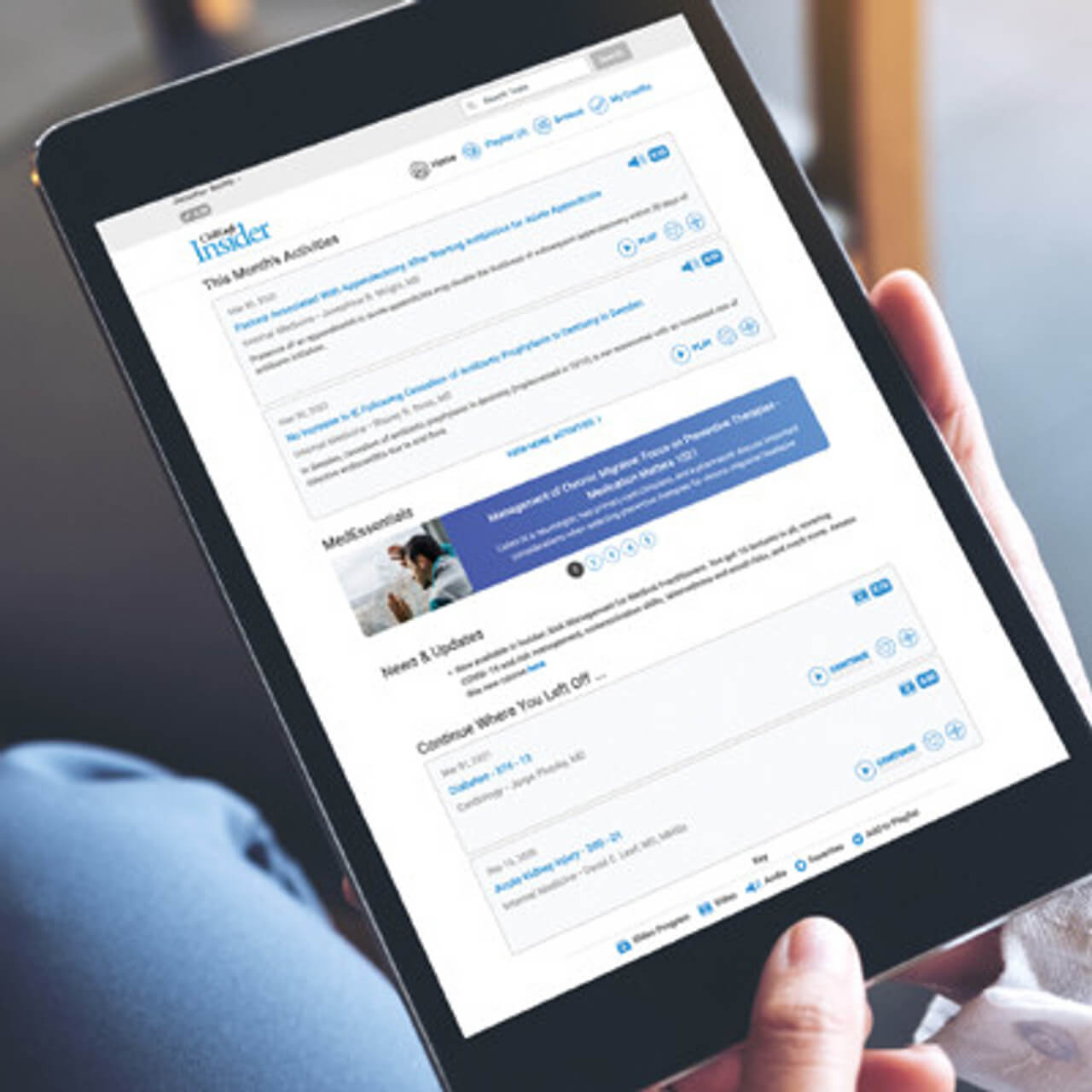
Oakstone CME CMEinfo Insider w/ up to $3,200 Gift Card
CMEinfo Insider is developed for medical professionals who want to save time & money. Get a $3,200 Amazon® gift card or save up to $3,200 when you join today!
Stay current on cutting edge content in your primary specialty, with a limitless opportunity to research topics important to you and your patients, earn unlimited AMA PRA Category 1 Credits,™ and take advantage of exceptional CME gift card opportunities.
A World of Medical Information at Your Fingertips
We partner with premier medical teaching institutions, professional associations, and highly regarded clinicians to deliver top-notch CME activities. They bring you the most relevant medical information for you to review and apply in your own practice.Connect to CMEinfo Insider and get:
- Comprehensive one-stop online resource for all stages of your medical career
- 24/7 access to the entire Insider library of board reviews, clinical updates, and journal article summaries from your computer, tablet or mobile device
- Earn all the AMA PRA Category 1 Credits™ you need
- Over 18,000 journal article summaries with audio commentary
- Over 1,230 board review and clinical update activities offered in video format
- New, cutting-edge topics added every month at no additional charge
- Online quizzes and instant pass/fail notification
- Unbiased and evidence-based content with no external advertising
- Pass board certification and maintenance of certification exams — guaranteed!
- Plus, save up to $3,200 or get up to a $3,200 Amazon® gift card when you join today! Please note that your receipt will be itemized per guidelines set forth by the ACCME for any accredited CME purchase sold in combination with a gift card. The gift card value is not a tax deductible professional expense. (See Gift Card Disclosures section below for further details.)
- Cost: $1999
- Credit hours: Unlimited
- CME credits awarded by: Oakstone Publishing
- Format: On-Demand Online, Online Video, Online Audio
- Material last updated: Continuously Updated
-
AudioDigest CME Wellness and Prevention of Disease Topical Collection
Take a more complete approach to health and wellness that integrates prevention, nutrition, mental wellness, and physical health for patients and medical professionals alike. Topics include cardiovascular disease, nutrition and supplements, professional burnout, weight loss methods, and many more. Relevant for Medical Doctors in multiple specialties, these lectures will empower you with practical tools and knowledge to improve overall health in a sustainable way.
See full details chevron_right- Cost: $399
- Credit hours: 34.5
- CME credits awarded by: Accreditation Council for Continuing Medical Education
- Format: audio
-
Cleveland Clinic Children’s 30th Annual Pediatric Board Review
Cleveland Clinic Children’s 30th Annual Pediatric Board Review is a nationally recognized, comprehensive activity that will benefit all clinicians practicing in this critical area of medicine. Primarily designed to prepare physicians for board certification or re-certification, this heavily detailed resource can help enhance clinical skills throughout the pediatric practice. A wide variety of topics are introduced in question and answer format, which highlights board relevant information and allows all learners to gauge their knowledge. General pediatric and specialty specific board simulation sessions will provide thoughtful discussions of answers and supporting rationale. Worth 43.25 AMA PRA Category I Credits™, this activity is also worth up to 43.25 MOC points in the American Board of Pediatrics’ (ABP) Maintenance of Certification (MOC) program.
See full details chevron_right- Cost: $795
- Credit hours: 43.25
- Format: On-Demand Online
- Material last updated: November 15, 2024
- Expiration of CME credit: November 14, 2026
-
FREE
ScientiaCME Management Of Lennox-Gastaut Syndrome (LGS) With Strategies That Have Legs
- Cost: Free
- Credit hours: 1
- CME credits awarded by: ScientiaCME
- Format: On-Demand Online
- Material last updated: April 05, 2025
- Expiration of CME credit: April 05, 2027
-
SUBSCRIBE NOW AND SAVE 50%
Oakstone CME Practical Reviews
Practical Reviews offers journal summaries from leading medical journals. This activity makes earning CME credits quick and easy and helps physicians stay up to date on the latest advances and news in their specialty.
Practical Reviews is offered in over 20 specialties and can be accessed via online video, online audio, audio cd, or the convenient Practical Reviews mobile app.
See full details chevron_right- Cost: Varies depending on course
- Credit hours: 56-70
- CME credits awarded by: Oakstone Publishing
- Format: On-Demand Online, Online Video, Online Audio, Audio CD, Mobile App
- Material last updated: Continuously Updated
-
AudioDigest CME Medical Ethics
Navigate ethical challenges in patient care, clinical decision-making, and professional accountability. Topics include end-of-life care, healthcare disparities, confidentiality, and disclosure of medical errors. Relevant for providers in all specialties, this collection was curated to ensure fair, just, and patient-centered practices while reinforcing the principles of dignity and respect in the healthcare community.
See full details chevron_right- Cost: $99
- Credit hours: 12
- CME credits awarded by: Accreditation Council for Continuing Medical Education
- Format: On-Demand Online
-
FEATUREDRECOMMENDED
MDCalc CME Bundle w/ $3,500 Amazon or Visa Gift Card
Maximize your CME allowance with MDCalc and get up to a $3,500 bonus gift card of your choice. Earn AMA PRA Category 1 CreditsTM for clinical content on 150+ calculators across multiple medical specialties. Easily earn and redeem CME at the point-of-care, online on our website or mobile app. Over 1 million medical professionals use MDCalc’s 550+ tools daily to support clinical decision making at the bedside.
See full details chevron_right- Cost: Varies
- Credit hours: Unlimited
- CME credits awarded by: EBMedicine
- Format: On-Demand Online
- Material last updated: Continuously Updated
-
30% OFF W/ CODE: CME30
Oakstone CME Optimizing Transition from Pediatric to Adult Care
Practical, Results-Focused CME
Throughout the online video CME program Optimizing Transition from Pediatric to Adult Care, recognized experts share strategies and best practices that can be readily implemented by pediatric, family medicine, internal medicine, or subspecialty providers as they tailor patient transfer plans based on age, disease type, and physical/intellectual capabilities.
This in-depth continuing medical education course includes case-based lectures on chronic conditions like diabetes, cystic fibrosis, congenital heart disease, epilepsy, cancer survivorship, organ transplantation, substance use disorder, etc. Along with assessing patient readiness and timing transitions for the best outcome, you’ll learn to optimize how you:
- Ensure adherence, teach self-care, and help patients maximize independence
- Promote medical and educational self-advocacy
- Address sexual health and fertility with young adults
- Strengthen family engagement
- Provide care for college students
- Screen for high-risk behaviors
Target Audience
This activity was designed for physicians, NPs, and PAs in: pediatrics, internal medicine, family medicine, medicine-pediatrics, pediatric subspecialties, medical specialties and subspecialties; and psychologists, social workers, and counselors who support young adults and their families.
See full details chevron_right- Cost: $895
- Credit hours: 32
- Format: On-Demand Online
- Material last updated: October 15, 2024
- Expiration of CME credit: October 14, 2027
-
FREE
ScientiaCME Navigating the progressive familial intrahepatic cholestasis (PFIC) landscape: unmet needs and treatment options
- Cost: Free
- Credit hours: 1
- Format: On-Demand Online
- Material last updated: 07/12/2024
- Expiration of CME credit: 07/12/2026
-
FREE
ScientiaCME Recognition and management of epidermolysis bullosa: what the clinician needs to know
- Cost: Free
- Credit hours: 1
- Format: On-Demand Online
- Material last updated: 02/28/2024
- Expiration of CME credit: 02/28/2026
-
FREE
ScientiaCME Pediatric and adolescent Crohn’s disease: therapeutic updates and optimizing medical and nutritional treatment
- Cost: Free
- Credit hours: 1
- Format: On-Demand Online
- Material last updated: 03/12/2024
- Expiration of CME credit: 03/12/2026
-
ClinicalPulse for Nurse Practitioners
A trusted CE solution developed specifically for Nurse Practitioners that simplifies on-the-go learning, tracks your progress, and fits your learning and lifestyle. This all-in-one platform lets you quickly earn CE and make the most of your time.
See full details chevron_right- Cost: $395
- Credit hours: Earn up to 75 contact hours and 20 Rx hours with a one-year subscription
- CME credits awarded by: American Nurses Credentialing Center's (ANCC's) Commission on Accreditation
- Format: Mobile app with audio, video, and written summaries
-
BONUS GIFT CARD
AudioDigest CME Pediatrics Platinum Membership
The AudioDigest CME + CE + MOC Pediatrics Platinum Membership is our most comprehensive plan available. Get unlimited access to every lecture in our library across all specialties, including over 4,000 evidence-based audio lessons and written summaries with suggested readings and test questions certified for CME, CE, and MOC credits across 14 specialties.
See full details chevron_right- Cost: $999
- Credit hours: 4,300+
- CME credits awarded by: Accreditation Council for Continuing Medical Education
- Format: Audio