Neurology CME
1 - 15 of 23 results
BoardVitals Neurology CME Board Review
The BoardVitals Neurology CME Review offers clinicians 100 AMA PRA Category 1 CreditsTM, 100 ABPN SA points, and over 1,800 Neurology board review questions. The questions cover key topics including neuromuscular issues, headaches, and trauma. This question bank will assist clinicians with Neurology certification and recertification.
The BoardVitals Nephrology CME Review also features:
- Quick and Convenient CME
- Computer, phone, and tablet access
- Constantly updated up-to-date questions
- Questions that are targeted specifically to the exam
- Online CME tracker
- 100% Pass Guarantee
- Statistical comparison to other Neurology test-takers (Nationally)
After completing this activity, you should be able to:
- Describe the underlying pathophysiology of neurology disease
- Interpret exam, history, laboratory and imaging findings to make a diagnosis
- Understand the appropriate work up and management of neurologic disorders
- Recognize potential adverse effects of treatment and assess potential risk vs benefit
Target Audience: Neurologists
See full details chevron_right- Cost: $599
- Credit hours: 100
- CME credits awarded by: BoardVitals
- Format: On-Demand Online
- Material last updated: Continuously Updated
Cleveland Clinic 15th Annual Neurology Update
The Cleveland Clinic 15th Annual Neurology Update addresses the latest clinically focused trends and most pertinent topics in the specialty. A faculty of 17 acclaimed experts provide the newest information regarding the diagnosis, medication and therapy for a wide range of neurologic conditions. Worth 15.5 AMA PRA Category I Credits™, this wealth of information will widen healthcare practitioners’ neurologic knowledge base and enhance patient care.
See full details chevron_right- Cost: $495
- Credit hours: 15.5
- Format: On-Demand Online
- Material last updated: October 7, 2024
- Expiration of CME credit: October 6, 2026
- 15% OFF W/ CODE: CME15FEATUREDRECOMMENDED
Oakstone CME CMEinfo Insider w/ up to $3,200 Gift Card
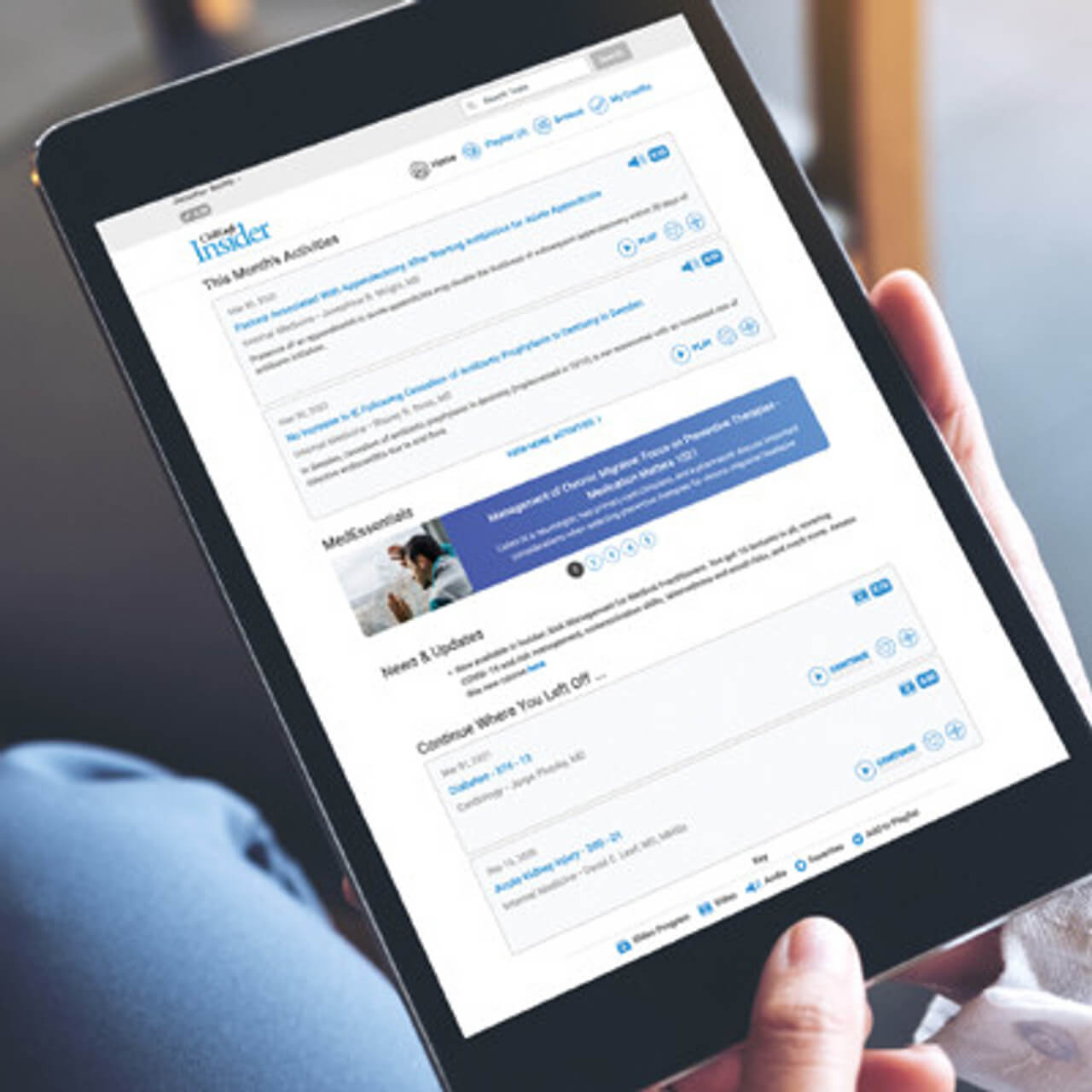
CMEinfo Insider is developed for medical professionals who want to save time & money. Get a $3,200 Amazon® gift card or save up to $3,200 when you join today!
Stay current on cutting edge content in your primary specialty, with a limitless opportunity to research topics important to you and your patients, earn unlimited AMA PRA Category 1 Credits,™ and take advantage of exceptional CME gift card opportunities.
A World of Medical Information at Your Fingertips
We partner with premier medical teaching institutions, professional associations, and highly regarded clinicians to deliver top-notch CME activities. They bring you the most relevant medical information for you to review and apply in your own practice.Connect to CMEinfo Insider and get:
- Comprehensive one-stop online resource for all stages of your medical career
- 24/7 access to the entire Insider library of board reviews, clinical updates, and journal article summaries from your computer, tablet or mobile device
- Earn all the AMA PRA Category 1 Credits™ you need
- Over 18,000 journal article summaries with audio commentary
- Over 1,230 board review and clinical update activities offered in video format
- New, cutting-edge topics added every month at no additional charge
- Online quizzes and instant pass/fail notification
- Unbiased and evidence-based content with no external advertising
- Pass board certification and maintenance of certification exams — guaranteed!
- Plus, save up to $3,200 or get up to a $3,200 Amazon® gift card when you join today! Please note that your receipt will be itemized per guidelines set forth by the ACCME for any accredited CME purchase sold in combination with a gift card. The gift card value is not a tax deductible professional expense. (See Gift Card Disclosures section below for further details.)
- Cost: $1999
- Credit hours: Unlimited
- CME credits awarded by: Oakstone Publishing
- Format: On-Demand Online, Online Video, Online Audio
- Material last updated: Continuously Updated
- 15% OFF W/ CODE: CME15RECOMMENDED
Oakstone MKSAP 19 Audio Companion
Expert Advice and Insightful Commentary
The MKSAP® 19 Audio Companion sheds light on the latest diagnostic approaches, management strategies, and treatment guidelines. In this comprehensive audio CME program, you’ll join host Donald L. Deye, MD, FACP, as he leads lively discussions with esteemed colleagues in 11 internal medicine subspecialties. Listen as experienced clinicians from some of the world’s finest medical institutions share patient stories, insightful views of recent clinical advances, and more.
Anytime, Anywhere Audio CME
With the MKSAP 19 Audio Companion, you get:
- All-new advice and commentary — a reliable, and entertaining way to learn current oncology trends, the latest approaches to diabetes treatment, COVID updates, new tactics for managing patients with COPD, and so much more
- An easy way to prep for your ABIM certification or MOC exam
- Flexible learning to fit your schedule — in your car, between appointments, while you work out
- Companion booklets — high-impact PDF learning aids to quickly review and retain key points (print booklets available for an additional charge)
- The opportunity to earn AMA PRA Category 1 Credits™ and ABIM MOC points
- Four FREE sets of extension questions — a $350 value that brings you incremental AMA PRA Category 1 Credits™ and MOC points
Audience
General internists and primary care physicians; subspecialists who need to remain up to date in internal medicine; residents preparing for the certifying examination in internal medicine; physicians preparing for the recertification examination.
Learning Objectives
- Discuss the most clinically relevant patient care information in all subspecialties of Internal Medicine based on the medical literature of the last 3 to 5 years
- Describe clinical situations in which this new knowledge will improve the quality of care
- Diagnose disease states that are less common and sometimes overlooked and confusing
- Determine when to refer patients for surgery or care by subspecialists
- Cost: $1297
- CME credits awarded by: Oakstone Publishing, LLC
- Format: On-Demand Online, Online Audio, Audio CD
- Material last updated: July 1, 2024
- Expiration of CME credit: August 31, 2026
Cleveland Clinic 13th Annual Neurology Update
Cleveland Clinic’s 13th Annual Neurology Update features a faculty of more than a dozen thought leaders discussing the most current clinically focused information regarding diagnosis, medication and therapy for a wide variety of neurologic conditions. This comprehensive review will detail strategies, procedures and best practices throughout the specialty. Neurologists, general practitioners, nurses and physician assistants will all benefit from the latest information impacting the practice and patient care. Worth 15 AMA PRA Category I Credits™, with ANCC and AAPA accreditation provided as well!
See full details chevron_right- Cost: $495
- Credit hours: 15
- Format: On-Demand Online
- Material last updated: 10/1/22
- Expiration of CME credit: 9/30/24
- FEATUREDRECOMMENDED
MDCalc CME Bundle w/ $3,500 Amazon or Visa Gift Card
Maximize your CME allowance with MDCalc and get up to a $3,500 bonus gift card of your choice. Earn AMA PRA Category 1 CreditsTM for clinical content on 150+ calculators across multiple medical specialties. Easily earn and redeem CME at the point-of-care, online on our website or mobile app. Over 1 million medical professionals use MDCalc’s 550+ tools daily to support clinical decision making at the bedside.
See full details chevron_right- Cost: Varies
- Credit hours: Unlimited
- CME credits awarded by: EBMedicine
- Format: On-Demand Online
- Material last updated: Continuously Updated
- FREE
ScientiaCME Neuropsychiatry-Neurology
Target Audience: Neurologists
See full details chevron_right- Cost: Free
- Credit hours: 3.75
- CME credits awarded by: ScientiaCME
- Format: On-Demand Online
- Expiration of CME credit: Two years after release
AudioDigest CME Neurology Platinum Membership
The AudioDigest CME + CE + MOC Neurology Platinum Membership is our most comprehensive plan available. Get unlimited access to every lecture in our library across all specialties, including over 4,000 evidence-based audio lessons and written summaries with suggested readings and test questions certified for CME, CE, and MOC credits across 14 specialties.
See full details chevron_right- Cost: $999
- Credit hours: 4,300+
- CME credits awarded by: Accreditation Council for Continuing Medical Education
- Format: Audio
BoardVitals Child Neurology Board Review Questions
BoardVitals Child Neurology Board Review Questions offers over 800 Child Neurology Board Review questions. Each question, answer, and explanation is reviewed and rated.
Board Vitals Child Neurology Board Review question banks offer:
• Detailed Explanations and Rationales associated with every question
• Timed Mode or Study Mode (So you can simulate real exam conditions)
• 100% Pass Guarantee
• Graphs and charts to compare yourself against the national averageTarget Audience: Child Neurologists.
See full details chevron_right- Cost: $139
- Credit hours: 100
- CME credits awarded by: University of Nebraska Medical Center
- Format: On-Demand Online
- Material last updated: Continuously Updated
- FEATURED
BoardVitals Neurology MOC & Certification Study Guide
The BoardVitals Neurology MOC & Certification Study Guide offers over 1900 MOC Neurology practice questions specifically targeted to the 10 Year ABPN MOC Program and CMOC participants.
BoardVitals Neurology ABPN MOC Exam & Practice Questions include:
• Peer reviewed Neurology questions, answers, and detailed explanations
• ABPN Practice tests in review mode or timed mode
Individually suggested content based on your strengths and weaknesses (Computer Adaptive Testing)
• Each question is reviewed and ratedTarget Audience:
See full details chevron_right
Neurologists preparing for the Neurology ABPN MOC Exam.- Cost: $249
- Credit hours: 100
- CME credits awarded by: University of Nebraska Medical Center
- Format: On-Demand Online
- Material last updated: Continuously Updated
Oakstone CME Practical Reviews
Practical Reviews offers journal summaries from leading medical journals. This activity makes earning CME credits quick and easy and helps physicians stay up to date on the latest advances and news in their specialty.
Practical Reviews is offered in over 20 specialties and can be accessed via online video, online audio, audio cd, or the convenient Practical Reviews mobile app.
See full details chevron_right- Cost: Varies depending on course
- Credit hours: 56-70
- CME credits awarded by: Oakstone Publishing
- Format: On-Demand Online, Online Video, Online Audio, Audio CD, Mobile App
- Material last updated: Continuously Updated
- FREE
ScientiaCME Straightening out our approach to the management of cervical dystonia: optimizing treatment strategies
Activity Description / Statement of Need:
In this online, self-learning activity:
Cervical dystonia is the most common focal dystonia, characterized by involuntary muscular contractions resulting in abnormal head, neck, and shoulder movements in addition to posture that can cause tremor and pain. Early-onset dystonia can begin in infancy, childhood, or adolescence, and it generally progresses from focal to generalized. Adult-onset dystonia usually affects the upper part of the body; the origin of the dystonia determines the risk of spread. Cervical dystonia may appear as torticollis, laterocollis, anterocollis, or retrocollis. It may be distinguished from nondystonic hand tremor and essential tremor by the absence of limb tremor and the manner of neck movement. However, it is more difficult to distinguish from pseudodystonias, resulting in misdiagnosis and inappropriate treatment.
Target Audience:
The following HCPs: medical neurologists; physician assistants, nurse practitioners, and pharmacists who practice in neurology; and other clinicians who commonly encounter patients with cervical dystonia.
See full details chevron_right- Cost: Free
- Credit hours: 1.25
- CME credits awarded by: ScientiaCME
- Format: On-Demand Online
- Material last updated: May 19, 2023
- Expiration of CME credit: May 19, 2025
- 15% OFF W/ CODE: CME15
Oakstone CME Samuels Comprehensive Review of Neurology
Discover the Latest in Neurology CME
The Samuels Comprehensive Review of Neurology includes 65 one-hour lectures and offers a broad, evidence-based look at common and uncommonly seen disorders, as well as best practices in diagnosis and management. Authoritative and clinically experienced faculty share pearls, pitfalls, and practical continuing medical education updates.
Named for the late Dr. Marty Samuels, long-time Oakstone CME contributor, beloved educator, inspirational mentor, and legend in the field of neurology, this online video CME program provides important strategies — including judicious use of imaging and lab testing — that will help you treat patients with neurological disorders and achieve the best clinical outcomes.
See full details chevron_right- Cost: $995
- Credit hours: 59
- CME credits awarded by: Oakstone Publishing
- Format: On-Demand Online, USB Flash Drive
- Material last updated: December 31, 2023
- Expiration of CME credit: December 30, 2026
MDCalc Stroke CME
Your MDCalc CME subscription includes 15 AMA PRA Category 1 Credits™, with up to 10.5 credits available in the Stroke specialty.
Easily earn and redeem CME as you use review CME eligible calculator content. Over 1 million medical professionals use MDCalc’s over 550 tools daily to support clinical decision making at the bedside. Earn CME with the following Stroke calculators:
- FUNC Score
- ASTRAL Score
- ATRIA Bleeding Risk
- HEMORR2HAGES Score
- Hunt & Hess Classification
- Intracerebral Hemorrhage (ICH) Score
- MEWS Score
- mSOAR Score
- NEWS Score
- NIH Stroke Scale (NIHSS)
- RACE Scale
- SEDAN Score
- tPA Dosing for Stroke Calculator
- Cost: $199
- Credit hours: 15
- CME credits awarded by: EB Medicine and MD Aware, LLC.
- Format: On-Demand Online, Mobile App
- 15% OFF W/ CODE: CME15
Oakstone CME Neurology for Non-Neurologists
Expert CME Review of Neurological Conditions
Neurology for Non-Neurologists is an updated collection of concise 30- to 45-minute video CME lectures presented by faculty who excel in their clinical and teaching expertise. It covers all clinical neurology subspecialties and includes 70 lectures on the common and uncommon neurological problems encountered in the non-neurologist’s practice.
This online continuing medical education program will improve your ability to positively impact the care of patients with neurological symptoms and help bring about the best possible outcomes. Along with lectures discussing innovations, disparities, and inclusivity of neurological care, highlighted topics include:
- Holistic care of the Parkinson’s patient
- Stroke recovery
- CGRP inhibitors and migraine treatment
- Electrolyte disorders
- Neuro-palliative care
- TBI diagnosis and treatment
- and more…
- Cost: $695
- Credit hours: 36.5
- CME credits awarded by: Oakstone Publishing
- Format: On-Demand Online, Online Video, Online Audio, Audio CD
- Material last updated: August 31, 2022
- Expiration of CME credit: August 31, 2025