Cardiology CME
1 - 15 of 33 results
-
BoardVitals Cardiology CME Board Review
The BoardVitals Cardiology CME Review offers clinicians 65 AMA PRA Category 1 CreditsTM, 65 ABIM MOC points, and over 1,300 Cardiology board review questions. The questions cover key topics including congenital disorders, valvular disease, and interventional cardiology. This question bank will assist clinicians with Cardiology certification and recertification.
The BoardVitals Cardiology CME Review also features:
- Quick and Convenient CME
- Computer, phone, and tablet access
- Constantly updated up-to-date questions
- Questions that are targeted specifically to the exam
- Online CME tracker
- 100% Pass Guarantee
- Statistical comparison to other Cardiology test-takers (Nationally)
After completing this activity, you should be able to:
- Make a diagnosis
- Order and interpret results
- Assess risk, determine prognosis, and apply principles from epidemiologic studies
- Describe the underlying pathophysiology of disease and basic science knowledge
Target Audience: Cardiologists
See full details chevron_right- Cost: $599
- Credit hours: 65
- CME credits awarded by: BoardVitals
- Format: On-Demand Online
- Material last updated: Continuously Updated
-
FEATUREDRECOMMENDED
MDCalc CME Bundle w/ $3,500 Amazon or Visa Gift Card
Maximize your CME allowance with MDCalc and get up to a $3,500 bonus gift card of your choice. Earn AMA PRA Category 1 CreditsTM for clinical content on 150+ calculators across multiple medical specialties. Easily earn and redeem CME at the point-of-care, online on our website or mobile app. Over 1 million medical professionals use MDCalc’s 550+ tools daily to support clinical decision making at the bedside.
See full details chevron_right- Cost: Varies
- Credit hours: Unlimited
- CME credits awarded by: EBMedicine
- Format: On-Demand Online
- Material last updated: Continuously Updated
-
SAVE 50% OR EARN UP TO A $3200 GIFT CARDFEATUREDRECOMMENDED
Oakstone CME CMEinfo Insider w/ up to $3,200 Gift Card
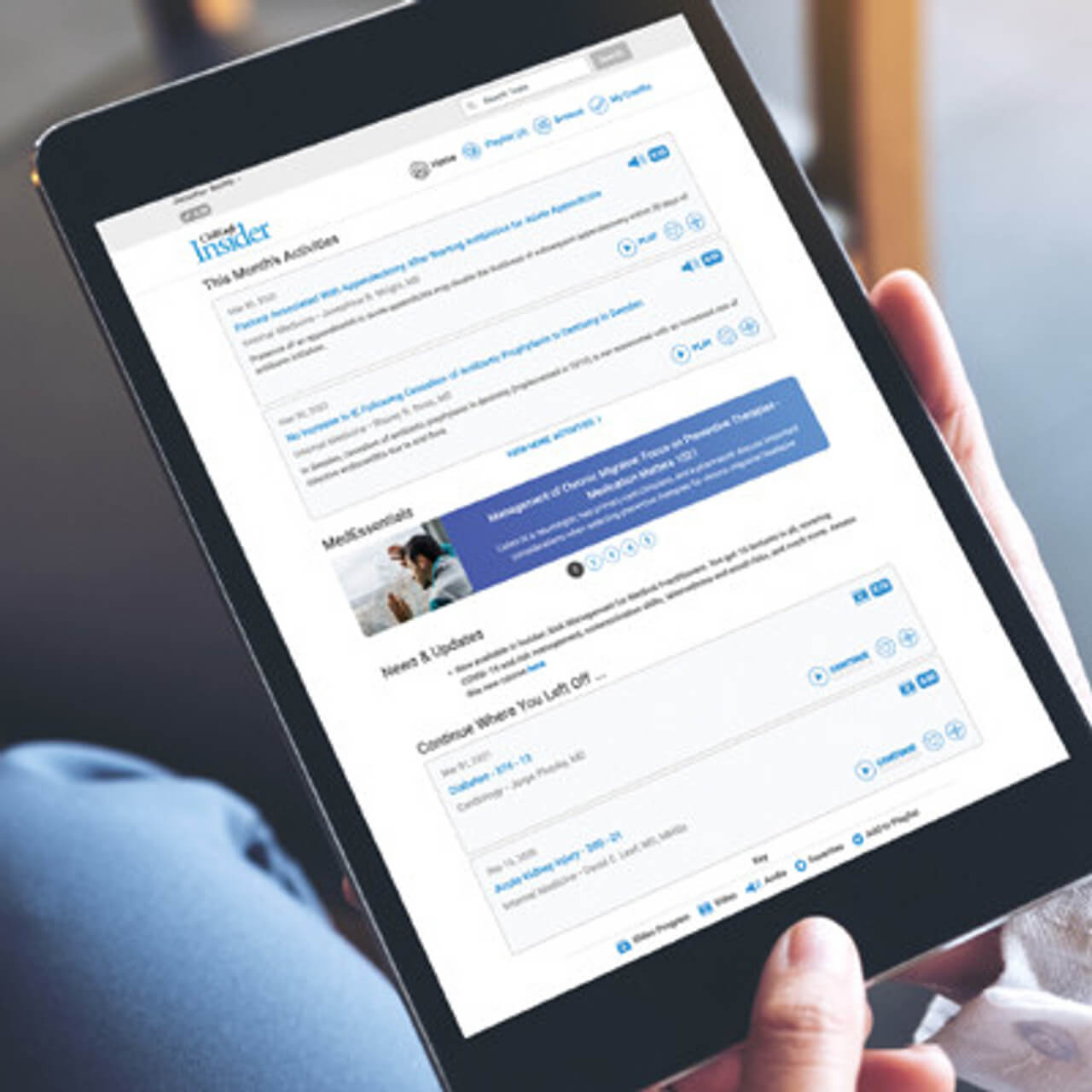
CMEinfo Insider is developed for medical professionals who want to save time & money. Get a $3,200 Amazon® gift card or save up to $3,200 when you join today!
Stay current on cutting edge content in your primary specialty, with a limitless opportunity to research topics important to you and your patients, earn unlimited AMA PRA Category 1 Credits,™ and take advantage of exceptional CME gift card opportunities.
A World of Medical Information at Your Fingertips
We partner with premier medical teaching institutions, professional associations, and highly regarded clinicians to deliver top-notch CME activities. They bring you the most relevant medical information for you to review and apply in your own practice.Connect to CMEinfo Insider and get:
- Comprehensive one-stop online resource for all stages of your medical career
- 24/7 access to the entire Insider library of board reviews, clinical updates, and journal article summaries from your computer, tablet or mobile device
- Earn all the AMA PRA Category 1 Credits™ you need
- Over 18,000 journal article summaries with audio commentary
- Over 1,230 board review and clinical update activities offered in video format
- New, cutting-edge topics added every month at no additional charge
- Online quizzes and instant pass/fail notification
- Unbiased and evidence-based content with no external advertising
- Pass board certification and maintenance of certification exams — guaranteed!
- Plus, save up to $3,200 or get up to a $3,200 Amazon® gift card when you join today! Please note that your receipt will be itemized per guidelines set forth by the ACCME for any accredited CME purchase sold in combination with a gift card. The gift card value is not a tax deductible professional expense. (See Gift Card Disclosures section below for further details.)
- Cost: $1999
- Credit hours: Unlimited
- CME credits awarded by: Oakstone Publishing
- Format: On-Demand Online, Online Video, Online Audio
- Material last updated: Continuously Updated
-
Cleveland Clinic 27th Annual Structural Valve Imaging Summit
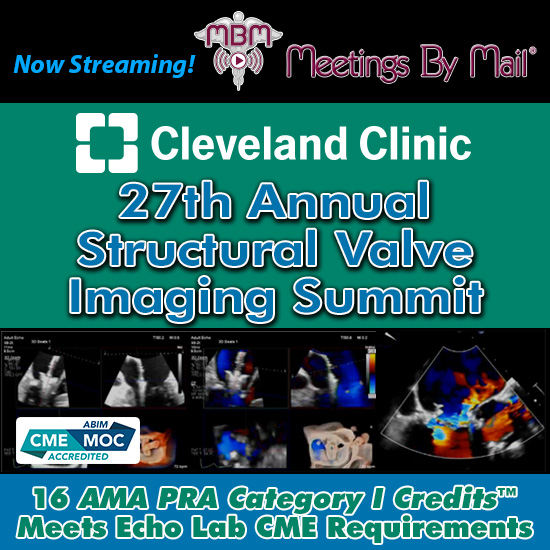
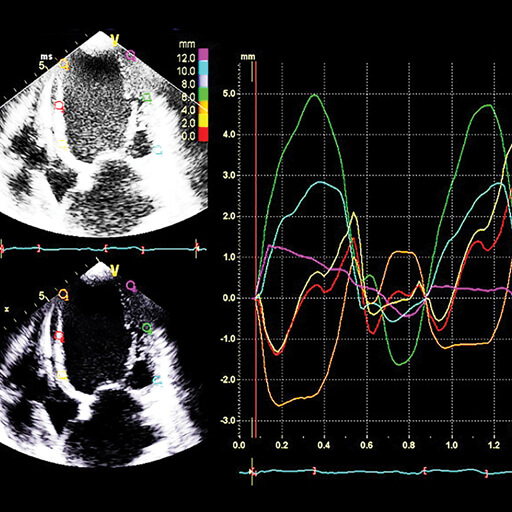
Cleveland Clinic’s 27th Annual Structural Valve Imaging Summit provides a comprehensive overview of valve disease, structural interventions, and cardiac imaging. An expert faculty discusses state-of-the-art technology and advanced imaging topics such as strain and 3-D, pericardial diseases, amyloid, HCM, and artificial intelligence. In addition to didactic lectures, this summit features complex case presentations, workshop demonstrations, and spirited debates over several controversial topics. Worth 16 AMA PRA Category I Credits™, this enduring material meets Echo Lab CME requirements. Additionally, physicians can earn 16 ABIM MOC points for this activity.
See full details chevron_right- Cost: $595
- Credit hours: 16
- CME credits awarded by: 16 AMA PRA Category I Credits™ Meets Echo Lab CME Requirements
- Format: Conference
- Material last updated: 4/30/25
- Expiration of CME credit: 4/29/27
-
SUBSCRIBE NOW AND SAVE 50%
Oakstone CME Practical Reviews
Practical Reviews offers journal summaries from leading medical journals. This activity makes earning CME credits quick and easy and helps physicians stay up to date on the latest advances and news in their specialty.
Practical Reviews is offered in over 20 specialties and can be accessed via online video, online audio, audio cd, or the convenient Practical Reviews mobile app.
See full details chevron_right- Cost: Varies depending on course
- Credit hours: 56-70
- CME credits awarded by: Oakstone Publishing
- Format: On-Demand Online, Online Video, Online Audio, Audio CD, Mobile App
- Material last updated: Continuously Updated
-
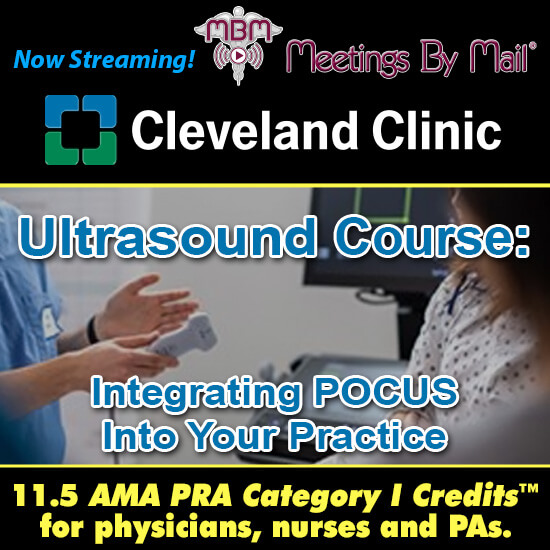
Cleveland Clinic Ultrasound Course: Integrating POCUS Into Your Practice
The Cleveland Clinic Ultrasound Course: Integrating POCUS Into Your Practice will provide physicians, nurses and physician assistants with foundational skills and state-of-the-art techniques for diagnosis and guiding procedures for point of care ultrasound. The lessons taught throughout this activity can be easily incorporated into current practices to immediately enhance patient care. More than 20 experts from Cleveland Clinic provide a didactic primer and workshops that will rapidly develop skills to maximize this increasingly important diagnostic and interventional tool. Worth 11.5 AMA PRA Category I Credits™, with ANCC and AAPA accreditation provided, as well. Also worth ABIM and ABA MOC!
See full details chevron_right- Cost: $345
- Credit hours: 11.5
- CME credits awarded by: Cleveland Clinic Center for Continuing Education
- Format: On-Demand Online
- Material last updated: 7/16/24
- Expiration of CME credit: 7/15/26
-
The Ultimate Master Clinicians CME Conference Bundle
Grow your clinical expertise with The Ultimate Master Clinicians CME Conference Bundle, an expert-led curated series covering urgent care, telemedicine, women’s health, and more. Designed for the clinician’s busy schedule, these on-demand lectures offer useful insights and knowledge to improve decision-making and treatment strategy.
See full details chevron_right- Cost: $849
- Credit hours: 53.5
- CME credits awarded by: Master Clinicians is accredited by the Accreditation Council for Continuing Medical Education (ACCME) to provide continuing medical education for physicians. This educational activity is eligible for 53.5 Category 2-B credit hours by the American Osteopathic Association.
- Format: On Demand Online
-
FEATUREDRECOMMENDED
Master Clinicians CME
Master Clinicians is a CME company focused on education in the emerging fields of urgent care, telemedicine, women’s health, as well as emergency medicine. Our educators and guest speakers are from organizations such as Experity, NextCare, AFC Urgent Care, MedExpress, Mount Sinai, Northwell, CityMD, Johns Hopkins and more.
Earn Your CME Credits
Anytime, Anywhere, Any Device!
- Lecture Series – Master Clinicians mentors teach high yield topics and share practical information you can use at your practice the next day. These one hour CME audio lectures with video slides are organized to allow you to learn at your pace and are designed for the MD, PA, & NP seeking master level CME training courses.
- Conference On-Demand – A collection of our online lectures bundled together. We gather the best experts to provide clinicians with unique access to industry leading insight in these emerging fields. Choose from our Urgent Care, Telemedicine, Women’s Health and more. It’s more value and more CME combined together.
- Mastery Workshops – Our mastery level procedural and skills workshop video lectures are taught by some of our best Master Clinicians Mentors. These 1-2 hour CME courses are hyper-focused on the knowledge, skill, and art of medicine. To obtain mastery of any procedural skill, you need to learn multiple techniques and know all the variations of common presentations.
- CME credits awarded by: Master Clinicians
- Format: On-Demand Online
-
30% OFF W/ CODE: CME30
Oakstone CME Comprehensive Review of Interventional Cardiology
Online CME: Updates in Interventional Cardiology
Comprehensive Review of Interventional Cardiology is a robust, in-depth continuing medical education guide to current guidelines and evidence-based best practices.
Led by Dr. Deepak L. Bhatt, skilled and authoritative clinician-educators cover this expansive field with 34 CME lectures focused on the latest diagnostic and procedural techniques, communication skills, technical ability and more. Key take-home points include:
- Functional Testing and Imaging. Exercise stress testing and coronary CT angiography are excellent approaches for coronary artery disease evaluation in low- to intermediate-risk patients. In intermediate- to high-risk patients, stress myocardial perfusion imaging, especially quantitative PET, is most effective.
- Saphenous Vein Grafts – Interventional Concepts. Because of the risk of distal embolization, Saphenous vein graft percutaneous coronary intervention is high risk, and should be performed with distal embolic protection when possible.
- Alcohol Septal Ablation for Hypertrophic Cardiomyopathy. Hypertrophic cardiomyopathy patients who meet clinical, anatomic, and hemodynamic indications should proceed to alcohol septal ablation or surgical myectomy in order to improve the heart failure state and improve prognosis.
- and more…
- Cost: $1095
- CME credits awarded by: Oakstone Publishing
- Format: On-Demand Online
- Material last updated: January 31, 2023
- Expiration of CME credit: January 31, 2026
-
30% OFF W/ CODE: CME30
Oakstone CME Echocardiography – A Comprehensive Review
Learn the Latest Guidelines with Online Cardiology CME
Oakstone’s Echocardiography – A Comprehensive Review provides an extensive, in-depth overview of all modalities of echocardiography used in the evaluation and management of patients with known or suspected heart disease. The 38 expertly-informed presentations offer insight into the morphologic features and physiologic functioning of the myocardium, valves, pericardium, coronary arteries, and great vessels.
Directed by Scott D. Solomon, MD and Maja Cikes, MD, PhD, this online cardiology CME course includes 38 evidence-based lectures organized in four sections: general principles, disorders, modalities, and settings. Skilled echocardiographers reflect on the substantial technological advances that have brought innovative clinical applications and enhanced diagnostic accuracy.
See full details chevron_right- Cost: $695
- Credit hours: 31.75
- CME credits awarded by: Oakstone Publishing
- Format: On-Demand Online, Online Video, Online Audio, Audio CD
- Material last updated: June 30, 2022
- Expiration of CME credit: June 30, 2025
-
SVU 47th Annual Conference: Vascular Imaging Educators Workshop (VIEW)
The all new Vascular Imaging Educators Workshop (VIEW) provides a complete educational experience for all who utilize vascular ultrasound. Approximately 40 experts from the Society for Vascular Ultrasound 47th Annual Conference discuss the hottest topics and latest techniques involved in the diagnosis and treatment of vascular disease. Worth 16 AMA PRA Category I Credits™, VIEW MEETS VASCULAR LAB CME REQUIREMENTS FOR ACCREDITATION WITH NO POST TEST. Also applicable to the American Board of Surgery’s Continuous Certification Program.
See full details chevron_right- Cost: $645
- Credit hours: 16
- Format: On Demand Online
- Material last updated: 2/15/25
- Expiration of CME credit: 2/14/28
-
StatPearls Unlimited Physician MD/DO/PA CME
Stay on top of your game with the StatPearls Physician Unlimited CME programs. With 6,046 activities, StatPearls is the largest CME provider in the world. These Pub-Med Indexed articles are categorized into 162 specialty areas which lets you better access activities that will make the biggest impact on your practice. One subscription allows access to all the activities, including all state-requirements.
Pricing Options
- 6 Month subscription: All 6,339 CME Activities – $249 per 6 months
- Annual subscription: All 6,339 CME Activities – $349 per 1 year
- Lifetime: All 6,339 CME Activities + Access to Board Reviews Forever – $1999
- Cost: Varies
- CME credits awarded by: ETSU
- Format: On Demand Online & Board Reviews
-
30% OFF W/ CODE: CME30
Oakstone CME Society for Vascular Medicine Comprehensive Review of Vascular Ultrasound Interpretation and Registry Preparation
Vascular Testing CME: “Head-to-Toe” Protocols
This online CME program spans 40 lectures that expose you to all aspects of non-invasive vascular testing. Abundant case study materials and over 100 registry-type exam questions will help those who work within the non-invasive vascular laboratory to prepare for the RPVI examination and maintain IAC Vascular Testing continuing medical education requirements. Nationally-renowned speakers provide expanded content on vascular lab operations and ergonomics, as well as valuable insight on:
• Imaging techniques (grayscale, color and spectral Doppler, physiological testing)
See full details chevron_right
• Various testing protocols and diagnostic criteria
• A broad range of vascular pathology, both common and rare
• Fundamentals of vascular physics
• Quality improvement and patient safety
• And more…- Cost: $895
- Credit hours: 15
- CME credits awarded by: Oakstone Publishing LLC
- Format: On-Demand Online, Online Video
- Material last updated: 6/30/2023
- Expiration of CME credit: 6/29/2026
-
30% OFF W/ CODE: CME30
Oakstone CME The Brigham Board Review and Comprehensive Update in Cardiology
Comprehensive, Current Cardiology CME Review
The Brigham Board Review and Comprehensive Update in Cardiology includes case-based lectures and in-depth discussions from cardiology experts, updated to current guidelines in clinical practice.
This online CME program is a thorough review of the core concepts and emerging trends in the field of cardiology, covering a wide range of topics: coronary and peripheral artery disease, heart failure, cardiovascular disease prevention, hypertension, obesity, non-invasive testing, pericardial and valvular heart disease, atrial fibrillation, and more. It’s continuing medical education that will help you to better:
- Apply knowledge gained to the ABIM certification/recertification cardiology board exams
- Perform differential diagnosis of complex clinical presentations related to cardiology disorders
- Identify and integrate current therapeutic options for specific cardiology disorders
- Analyze and interpret up-to-date literature relevant to clinical practice in cardiovascular medicine
- Express pathophysiology knowledge as it applies to cardiology disorders management
- Cost: $1195
- Credit hours: 26.75
- CME credits awarded by: Oakstone Publishing, LLC.
- Format: On-Demand Online, Online Video, Online Audio, Audio CD
- Material last updated: May 1, 2023
- Expiration of CME credit: April 30, 2026
-
MDCalc Cardiology CME
Your MDCalc CME subscription includes 15 AMA PRA Category 1 Credits™, with up to 23.5 credits available in the Cardiology specialty.
Easily earn and redeem CME as you use review CME eligible calculator content. Over 1 million medical professionals use MDCalc’s over 550 tools daily to support clinical decision making at the bedside. Popular Cardiac Care calculators with CME include:
- HEART Score for Major Cardiac Events
- Mean Arterial Pressure (MAP)
- Wells’ Score for PE
- PERC Rule
- TIMI Score for UA/NSTEMI
- Cost: $199
- Credit hours: 15
- CME credits awarded by: EB Medicine and MD Aware, LLC.
- Format: On-Demand Online, Mobile App